Showing posts with label Feminism. Show all posts

Tuesday, February 14, 2017

3 Media Lies About Intimacy You Didn't Know You Believed

How many times can we watch women being sold before we start to feel exploited ourselves?


Happy Valentine's Day, my dear friends.  I hope that you come to this post with your heart full of the validation we all hope for on this day, and especially that you can feel the warmth and the truth of your worth independent of any circumstance.  In short, I hope you come to this post feeling loved.

As I've mentioned once (or five hundred times), it's been a tough year.  One of the big struggles has been grieving my naivete about the goodness of humanity, and this partly because I've discovered that pornography use is rampant, even among those we cherish and look up to.  If you and your mate are fighting this battle against the destroyer, my love and prayers go out to you.  There is some pain too great to imagine, and since most couples are not able to share the struggle, they bravely face it alone. I wish I could sit and cry with you.  It is hard, so so hard.

This is not to say that all struggle with pornography addiction.  In fact I think it right to clarify that I am lucky enough to be married to a man who doesn't.

But everyone in this fallen world suffers from the effects of porn.  It exists on a spectrum: on one end are the most horrifying images and ideas one could imagine--on the other something as seemingly innocuous as a child's toy.  Each of us has a line we prefer to stay on the right side of, and while I'm not here to get you to move yours, I hope you can bravely examine how some of what we consider innocent could be harmful. Because we as women are being bought and sold like cattle every day.

And the men aren't the only ones buying in.

Lie #1  Your worth is based on your sexuality.

You think you can spot this one a mile away, but stay with me.

Of course we can all see the subtle messages aimed even at children.  Let's pass over the obvious fact that every Disney princess since 1989 (with the exception of Mulan) is portrayed with fantastic proportions and revealing clothing.

Let's even ignore the standard story line, used in everything from cartoons to reality TV to commercials, that has a guy ignoring a girl until she gets her dream makeover and is dressed to kill.
Blatantly, the message is immodesty=attention-from-the-guy-you-like.

Usually the media tears women down in far subtler ways.

Consider the storyline that has the woman using sex to get what she wants.  She lures, teases, maybe seduces the ape of the man who can give her a promotion, entrance to the top-secret lab, or tickets to a sold-out show.  It's often portrayed humorously, but the message is clear: sex is a commodity; you are a commodity.

Most of the time it manifests as the constant objectification of women in every form of media. Commercially, but also artistically, women are manipulated like props on a set for maximum sex appeal.  Take a woman, vamp her up, airbrush her, and make sure there are lots of revealing shots of her body to produce eye candy so you can sell everything from chewing gum to blockbuster action movies.  Women's bodies are no longer sacred, they're a commodity to be bought and sold.  And just to be extremely clear, when we see sisters used like that, something changes in us whether we know it or not.

Lie #2  Sex is selfish and sinful

Some TV shows and movies are so steeped in pre-marital sex from the first frame, that while there may be many hookups in your 120 minutes, the heroine may never get real love or respect by the end of the film. Let me translate: give sex first, and maybe, just maybe, you'll be valued and loved. Probably not, though, because there's lots of sex but not lots of love to go around.  

We consider the sex in these movies as inappropriate, the worst part of the movie, the part we fast forward through or wish we had.  How can all of this not train us to feel negatively or at least conflicted about sex?

And we're not even going to go near 50 Shades, because I hope with all my heart you know as little as I do about it.  

Lie #3 Married Sex is Boring

You would just assume that this is true if you take your ideas straight from Hollywood, which represents married sex only 15% of the time versus extramarital sex 85% of the time.  But even if you chalk that up to unimaginative writers who can't find a way to build tension within a married relationship, what gives?  The statistics don't lie: married people have more sex, and more varied sex, and report higher levels of sexual satisfaction than those who aren't married.  Add to that your own experience.  If you don't know how hot married sex can be, find out.  Today is Valentine's Day, after all.

Could it be that even within sexually fulfilling relationships we could still be buying the "grass is always greener" garbage the media is selling?  And if we are, how does that show up?  Well, I don't want to cross any lines here, but maybe if we're told married sex is boring, that's what we expect and that's what we get?

Ahem.  Enough said.

It's not just the men.

We think we're above these messages.  We think that guys shouldn't watch movies that objectify women, but that it's okay for us.

How many times can we watch women being used as sex objects before we become jaded and cynical? How many stories can we ingest where sex is inappropriate in every form--manifesting as lust, selfishness, and filth--before the pure and beautiful sex in our own lives starts feeling wrong?  How many times can we equate airbrushed, perfect women with desirability before we stop feeling desirable?  How many times can we see men portrayed as unfeeling sex maniacs before we stop trusting our husbands?

Again, you're thinking that you know sex is a good thing within marriage, but ask yourself this: how many times do you think you've misinterpreted your husband's desire for you as selfish?  How many times have you resisted him because you were afraid it didn't mean real love--that if he loved you, he'd have (fill in the blank.)  How many times have you struggled to enjoy yourself in bed because you are so hung up on what you think your husband wants you to look like?

It is time for thinking, feeling women and men alike to identify, reject, and fight these slanders against the human race.  We need to open our eyes to what messages are coming across, whether blatantly or subtly.  Spotting these lies is really half the battle.  Are we talking to our daughters about how unfair the media is to women?  Do we talk to friends about how objectifying women in public leads to distrust and insecurity in our own hearts?  And (you knew I was going there) are we turning off YouTube when one of our sisters is on-screen selling out?  Money talks, friends, and if we keep sending it to Hollywood, they'll assume we like the product.

The most important battleground, though, is in our hearts.  Think seriously about how a lifetime of media lies has influenced your feelings about yourself and about the men in your life.  Where you've been mistaken or mislead, start mending and rebuilding.  You may find yourself speaking a different language from the people around you, and that's okay--this is a conversation worth having.  We've only been getting one side of it for a very long time.  

Sunday, June 14, 2015

How Feminism is Still Hurting LDS Families--Part II

Last week I discussed some of the harmful outcomes of the feminist movement in our society at large.  If you missed it, I hope you'll go back and take a look.

So what does feminism mean to a woman who has already rejected most of its principles in her life, as I have?  What about those of us who never bought the liberal propaganda that told us to sleep around, delay marriage and family for as long as possible, and then to outsource our children to caregivers so that we can climb the corporate ladder?  In what some have called a post-feminist society, what part does its ideology even play in the lives of women like me?  And yes, I am finally getting to the point, so thank you for sticking with me this long:  Feminism has taken the fun out of being a woman. 

Thinking men as the enemy is no fun, and neither is thinking of our children as obstacles to self-fulfillment.  

As Wives
Do we treat our husbands with the same respect we demand of them?  Or have we fallen easy prey to the Orwellian trap of the oppressed becoming the oppressors?  Sometimes I try to imagine men saying and doing things that women get away with, and it makes me laugh.  It TJ demanded things of me the same way I do of him, we might not even still be married.  It's a huge double standard.

Where the feminist movement at large cultivates a grudge against men who have treated women wrongly, women in the church take up the same banner against men who have not.  We did not marry the losers Laura Schlessinger designated as "the three As" worth leaving altogether: adulterers, abusers, and addicts.  By and large we married men who honor the priesthood, strive to support us as wives and mothers, and want to be good fathers to their children.  We married men worthy of our respect, but we fail to give it to them.

Sadly, we have abandoned the spirit of meekness to embrace a spirit of competition and combativeness.  Instead of building our husbands up as leaders protectors, and providers in our homes, we sometimes undermine the very efforts they make to fulfill their God-given role.  When husbands lead out, wives often express doubt in their abilities; we show a lack of gratitude for them, we show resentment when their leadership succeeds and criticism when it fails; we loudly complain that our men are not more like women, and then when they try to please us by helping us in our role as nurturers, we laugh at their mistakes.  Worst of all is our tendency to discount our husbands' ideas, plans, hopes, skills, and desires.

It's tempting to think there is no problem here because there is no complaining.  But you won't hear husbands complain about overbearing wives to their overbearing wives, for two reasons: they are trying to be patient and unselfish; and they are afraid of backlash if they don't.  So they take this treatment for years and even decades before danger signs arise.  But eventually we see our husbands lose confidence in their abilities, and give up trying to lead.  And this is the terrible moment of self-fulfilling prophecy: when a man becomes the weakling his wife has always believed he was.

As Mothers
Feminism doesn't just take the fun out of being a wife.  It also takes the fun out of being a mother. And it does this by telling us a few key lies.

Gloria Steinem, one of the founders of the feminist movement, asserted, "A liberated woman is one who has sex before marriage and a job after."  That one's pretty easy for LDS women to reject, but similar ideas are promoted everywhere in modern culture, and because they are so subtle, they're hard to identify.  We are told that we're wasting our time and talents on raising children.  We're told that a woman who stays home to take care of her family is bored, frustrated, and unhappy.  We're told that if our lives revolve around our husband and children, we are somehow missing out on a more fulfilling experience.  We are told that women who stay home for awhile with little ones become irrelevant by the time they choose to re-enter the workforce.  We are told that in order to raise a child right, you must take that extra work in order to afford the things that will make him happy, such as the latest gadgets, designer clothes, and a trip to Disneyland at least once a year.

Do we believe these lies?  No!  Well, maybe just a little.  Just enough to make us pause before we write "homemaker" next to the box marked "other" on that government form.  I am so grateful that I get to be a stay-at-home mom, but I fervently hope that people can stop thinking of my lot as frumpy, exhausted slaves to our families.  And to be perfectly honest, I need to get this misconception out of my own head, as well.

Working moms suffer, too--and maybe, especially.  Feminism robs mothers of enjoying their children by insisting that we can and should "have it all"--which is liberal lingo for pursuing a career during the demanding early years of raising a family.

The great news is that most American women fit work around their families' needs, rather than giving in to feminist demands that professional advancement should come first.  Women work shorter hours, try to be home when their children are, and try as much as possible to have them cared for by family members.  They may miss out on career and pay advancements by doing this, but by and large moms are willing to make that sacrifice because they put their families first.

Some women simply have to work to provide basic necessities for their families.  And some work because they are happier that way.  I am not addressing these two groups of women.  I am addressing women who have been told all their lives that in order to be valuable members of society, they have to work while they're raising kids--and who are really suffering because of it.  Women who feel compelled to provide for their families often feel anxiety, stress, frustration, and guilt for what they're missing at home.  Which, needless to say, is not fun.

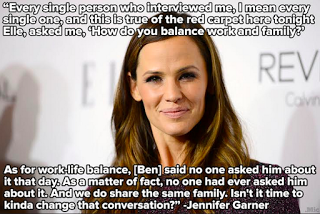
Jennifer Garner's simplistic view of what it means to be a mother illustrates the selfishness pushed by feminist thinkers, but it also begs the question: are mothers indeed under too much pressure?  Yes. We are.  But the pressure comes from feminism's lies--not from our own expectations of life with a family.  We are missing out on the joy of being mothers because we've forgotten it's the most important thing we'll ever do!

As Latter-Day Saint women, we can do better.

Forsaking Feminism
Let's go retro for a second and think about the archetypal housewife of the 1950s.  She looks great in her full skirt and her red lipstick.  She's overjoyed that the vacuum and washing machine are making her life easier.  She considers the state of her home an expression of who she is--she is "house-proud."  Her near-constant presence in the home allows her to know what is going on in her kids' lives and hearts.  When her husband comes home, she brings him a drink so he can relax with the paper.  Then she puts the finishing touches on a dinner the whole family can share together.  She is creative, resourceful, focused, grateful, and happy--and she seems to be having a whole lot of fun. Women back then did it with flair.

Feminists have been howling about these images of womanly contentment for half a century now. And I think this has us all a little skittish about fully embracing our work as homemakers.  Even when we choose to make our homes and families the centers of our lives, we're a little embarrassed about being too happy about it.  It's all so hopelessly out of fashion.  When was the last time you saw a woman waiting on her husband, getting excited about homemaking hacks, or priding herself on a beautiful meal?

I'm not saying we should try to look and act like Mary Tyler Moore.  A sincere focus on home and family does not necessarily mean our homes will look like a Pinterest board or that we will be slim, gorgeous, and smiling all the time.  Rather, I am suggesting that we stop listening for howling feminists and embrace our natural talent for nurturing.  I think we'd enjoy ourselves more if we did. LDS women are powerful not because we are seeking to wrest control of the world from men. We are powerful because we embrace the control we've always had--which power we share with men--the power to build up families.

Taking Femininity Back

Gordon B. Hinckley said, "People wonder what we do for our women.  I will tell you what we do. We get out of their way and look with wonder at what they are accomplishing."  That is the way a prophet of God views the women of the church.  Do we view ourselves that way?

We can take back the joy of motherhood by taking back our identity.  Where the world insists we are wasting our talents, we can persist in the knowledge that there is no better place for them to be used than the home.  Where the world markets a sleek, expensive version of child-rearing, we can be secure in the knowledge that no materialistic lifestyle can equal the impact a mother has on her child's life.

As women of God, we must eschew the subtle treachery of worldly teachings that would undermine our strength.  We can cling instead to the teachings of living prophets.  It is tempting for me to devote this entire section to quoting "The Family: A Proclamation to the World" verbatim.  It is simple.  It is profound.  It is the most inspired counsel to families I have ever read.  Have you read it lately?  I confess I don't read it nearly often enough, and I challenge you to take a close look at its teachings in light of what I've discussed here.  What does the Proclamation teach women about how to live a joyful life? Here are just a few noteworthy phrases:

Gender is an essential characteristic of individual premortal, mortal, and eternal identity and purpose... The family is ordained of God.  Marriage between man and woman is essential to His eternal plan... Happiness in family life is most likely to be achieved when founded upon the teachings of the Lord Jesus Christ.  Successful marriages and families are established and maintained upon principles of faith, prayer, repentance, forgiveness, respect, love, compassion, work, and wholesome recreational activities.  By divine design, fathers are to preside over their families in love and righteousness and are responsible to provide the necessities of life and protection for their families.  Mothers are primarily responsible for the nurture of their children.  In these sacred responsibilities, fathers and mothers are obligated to help one another as equal partners. Disability, death, or other circumstances may necessitate individual adaptation. Extended families should lend support when needed.
The amount of fun--the amount of joy and satisfaction--we have as women depends on whose vision of ourselves we buy.  And it would be lovely if we could just choose once and for all to buy God's vision, but I believe it has to be an ongoing process of searching His word and implementing it in our lives.

Here are a few scriptures that might be useful for a feminist seeking to reclaim her femininity.  The first one, ironically, was specifically given as counsel to the priesthood:
No power or influence can our ought to be maintained by virtue of [being a woman], only by persuasion, by long-suffering, by gentleness and meekness, and by love unfeigned; by kindness, and pure knowledge, which shall greatly enlarge the soul without hypocrisy, and without guile...  
 D&C 121:41-42
Forgive me for taking such a huge liberty in applying that to us as sisters, but with the entitlement we've come to feel from the feminist movement, it's worth considering.  Do we consider it our place to rule the home, simply because we are women?
And now I would that ye should be humble, and be submissive and gentle; easy to be entreated; full of patience and long-suffering; being temperate in all things; being diligent in keeping the commandments of God at all times; asking for whatsoever things ye stand in need, both spiritual and temporal; always returning thanks unto God for whatsoever things ye do receive.   
Alma 7:23
Humility, patience, and gentleness are not exactly watchwords of the feminist movement, are they? But it's time for us to re-embrace these traditionally feminine traits.  If we love our husbands, we should speak well of them, serve them, seek their counsel, thank them for their hard work, and speak to them with love and respect.

Margaret D. Nadauld said:
Women of God can never be like women of the world.  The world has enough women who are tough; we need women who are tender.  There are enough women who are coarse; we need women who are kind.  There are enough women who are rude; we need women who are refined.  We have enough women of fame and fortune; we need more women of faith.  We have enough greed; we need more goodness.  We have enough vanity; we need more virtue.  We have enough popularity; we need more purity.
James E. Talmage wrote, "The greatest champion of woman and womanhood is Jesus the Christ."  I know this is true.  He is the source of our freedoms, our joys, our triumphs, and our hope.  As we strive to emulate his magnificent life, we will find our powers increase in ways that feminism never even dreamed.

* * *

P.S.:  Thank you so much for reading this post and for sharing it with friends.  Despite the staggering amount of time it took me to put it together, I'm well-aware that it is no masterpiece.  I found courage to publish it, however, because I feel strongly that LDS women deserve better.  There is so much to this topic that I really only got the tip of the iceberg here. If you are ready to challenge your ideas on feminism, I highly recommend the following reading:

The Flipside of Feminism by Suzanne Venker and Phyllis Schlafly
The Proper Care and Feeding of Husbands by Laura Schlessinger
"The Joy of Motherhood" by Margaret D. Nadauld
"Mothers Who Know" by Julie B. Beck
"Be Meek and Lowly of Heart" by Ulisses Soares

and, of course,

"The Family: A Proclamation to the World"

Sunday, June 7, 2015

How Feminism is Still Hurting LDS Families--Part I


Jennifer Garner made waves in Hollywood last fall by pointing out the world's double standard in expecting moms to take a larger role in the family than dads do.    But is she saying more should be expected of men, or less should be expected of women?  If you read the full speech and notice her humorous but jaded take on the questions posed to her husband, you might be inclined to think with me that Garner objects not to the low standards her husband gets by with, but the very high standard still set for mothers.

I'm not sure why this even made the news.  Feminism and its basic tenets have been broadcast by the media at a deafening volume for oh, the last fifty years.  Is there a single person still in doubt as to where Hollywood and the media elite stand on issues of the family?  And yet we are still having this conversation--because godly men and women just don't buy it.


We Think We're Feminists, But We're Not


The funny thing about feminism and Mormons is that even though we reject some of the more outrageous demands made by the movement, such as abortion, we believe in our hearts that feminism has done us some good.  Heck, if you had asked me a few months ago about it, I probably would have told you that I was a feminist.  This comes from a basic misunderstanding of the origins and aims of the movement, since I was born into a world that only told one side of the story.  And this confusion about feminism is harmful, especially if it’s never even addressed--because it leads us to allow harmful attitudes and mores to permeate and damage our families.


Feminism is typically divided into three main eras, or waves.  First wave feminists never even really identified themselves as anything but suffragettes, but since feminists like to claim that victory, let them have it.  Second wave feminism, which started in the sixties, focused primarily on social and economic equality for women.  Third wave feminism, which started in the nineties, is usually described as a backlash against some of the more egregious errors of its predecessor, but is so wide in its scope and includes so many varying viewpoints--women under this umbrella come down on opposite sides on such issues as prostitution and pornography-- that it barely qualifies as a movement.  In this paper, I focus primarily on second wave feminism, which is the root of so many of our problems.


So forget about what possible gains feminism may have given us for just a few minutes; ask yourself what we have lost either directly or indirectly because of the feminist movement.  


What do you come up with?


Perhaps your first thought is that feminism has decimated a generation of relationships by driving a wedge between husbands and wives. Feminism encourages women to think of themselves as victims of male domination, and to focus almost exclusively on self-fulfillment as a method of getting back what they've been denied for so long.  They are taught to use every means to subvert and castigate the men in their lives.  As Gloria Steinem famously said, "A woman without a man is like a fish without a bicycle."  This negative attitude toward men has become so entrenched in American culture that it is taken for granted that men are unnecessary--both in the lives of women and in the lives of their children.  It's not surprising that in this atmosphere marriages have declined and divorces increased in the past fifty years--rather, it's surprising that any survive.


But maybe you weren't thinking about men suffering.  Maybe you were thinking of what the kids have lost. Obviously, a feminist culture that condones and even promotes premarital sex produces a lot of children born out of wedlock; and a culture that glorifies and encourages divorce means that even kids whose parents were married have no guarantee of knowing their dads.  Studies show that kids who don't live with their biological dads are at unbelievably higher risk for problems with poverty, physical and emotional health, incarceration, crime, teen pregnancy, child abuse, drug and alcohol abuse, education, and childhood obesity.  And they’re not just missing out on their fathers--many children are missing out on their mothers, too, since mothers have flown the coop.  Third-rate day care takes its toll, and so does too much time at home without a parent.  


So the men suffer.  And the children suffer.  But at least feminism has helped and empowered women.  Right?


Wrong.  


“Despite the evidence that feminism has been a failure, women still think they identify with its basic premise.  Even conservative women believe the mass exodus of mothers from the home has been the "consequence of the great feminist revolution that stormed the barricades of the patriarchy and won a glorious victory.”             

This never happened.             


The most important factor that influenced the significant shift of American women into the workplace is the invention of laborsaving devices.  The folks to whom women are truly indebted are inventors Thomas Edison (electric lights), Elias Howe (the sewing machine), Clarence Birdseye (the process for frozen foods), and Henry Ford (the automobile).  Technology and the mechanization of housework—such as the washing machine, dryer, dishwasher, and vacuum cleaner—allowed women to turn their attention away from household duties.             


The birth control pill was another factor.  Americans love to associate “the Pill” with feminism; but it, along with machines of convenience, was invented before the 1960s—by men.  It was the contributions of men that gave women the time to work outside the home in record numbers.  Women should be thanking “the men who came before us”—not feminists.             


Moreover, the Great Depression forced women to seek employment when the men in their families could not get jobs.  During World War II, women in large numbers began to fill jobs for which men were unavailable.  The Equal Pay act of 1963 was also helpful.  It abolished wage disparity based on sex.  None of these factors—America’s inventors, the Great Depression, World War II, and the Equal Pay Act—have anything to do with feminism.  Dishesh D’Souza, the conservative author and president of King’s College in New York City, called the notion that feminism is responsible for the freedoms women have today “a lovely fairy tale.”

--Suzanne Venker and Phyllis Schlafly, The Flipside of Feminism, page 53


Hmm.  So the one and only thing I thought feminism had done right, it has stolen the credit for. Women already had the freedom to work outside the home before the feminist movement came along--they did not need a feminist badge or picket line to create opportunities for themselves.  Great women such as Amelia Earhart, Harriett Tubman, Marie Curie, Liz Taylor, Susan B. Anthony, and Louisa May Alcott, Mary Cassatt, and Helen Keller were using their time and talents to inspire and bless the world decades before the feminist movement gave them permission to do so. Did the workplace role out the red carpet for them? Perhaps not. But these powerhouses of women seemed to gain strength, if anything, from the obstacles they tackled.  

The fact that most women stayed home while raising families illustrates not the closed nature of the workplace, but the order of priorities most women had.  Feminism didn’t give us the ability to leave the home.  What feminism did do was to indoctrinate a generation of women with the notion that financial dependence on men was submission to male oppression, and to denigrate the titles of wife and mother.


Women have not been empowered by the feminist movement, but enslaved.  We used to have one role to fill; now we have two.  And it’s stressing us out.  Now, according to The Paradox of Declining Female Happiness, published by The American Economic Journal, “The lives of women in the United States have improved over the past 35 years by many objective measures, yet we show that measures of subjective well-being indicate that women’s happiness has declined both absolutely and relative to men.”


The Atlantic highlights the fact that our new-found “power” has not really liberated women:
The situation today is not, as Edin likes to say, a "feminist nirvana." The phenomenon of children being born to unmarried parents "has spread to barrios and trailer parks and rural areas and small towns," Edin says, and it is creeping up the class ladder. After staying steady for a while, the portion of American children born to unmarried parents jumped to 40 percent in the past few years. Many of their mothers are struggling financially; the most successful are working and going to school and hustling to feed the children, and then falling asleep in the elevator of the community college.
"The End of Men" from The Atlantic
And it's not just single women who are feeling the pressure to be in two places at once.  For a comical but beautifully honest take on the modern woman's angst, we can thank Jennifer Garner herself.  She plays a loving mother torn between work demands and the needs of her family in "Alexander and the Terrible, Horrible, No Good, Very Bad Day."  Strangely, even though this woman's character is supported by a loving husband who is willing to stay home while she pursues her career--and he does a great job of being a "fommy"--she feels both guilty and jealous about missing out on the daily trials and joys of her family.  She is so conflicted that, up to the last minute we're not sure if she'll choose to continue her hectic pace--but she does.  

Feminism has hurt men.  Feminism has hurt children.  And feminism has especially hurt women.  

I recently listened to an interview with Patricia and Jefferey R. Holland in which they discussed the early days of the feminist movement--which they lived through when they were at Yale together. Patricia commented on how, even in the sixties, it was easy to see that this cultural shift would be harmful to families, and especially to children.  I was especially struck by Elder Holland's comments:
I think the model was wrong.  What seemed to be the talk was..."how does a woman get out of the home, so to speak, or maybe even out of marriage...'  When I think that that model should have been turned 180 degrees then, to 'what do we do to guarantee that men stay in the home?  Or that men contribute in the home?'
 I'm all for shared workload.  We can do the dishes together, we can do the laundry together, and we can pay the bills together and figure out what the income tax is together.  But it seems to me that just to think of ways to get away from family and away from home was exactly, diametrically opposite to the model we should have been pursuing, and that is, in such times, how do you keep fighting to stay in the home?  Including a husband, including a father.  That he does not just blissfully walk out the door and take his little briefcase and go off and never have another thought all day...about the greatest responsibility he has and that is to be a husband and a father...  I think all the forces that spin us centrifugally away from the home, we have to fight that, and have those forces reversed as best we can, and have that circle coming back into the home.  
And this brings me to the reason I've felt moved to write about this.  Sitting in General Conference this April I was inspired when Sister Bonnie Oscarson echoed Elder Holland's sentiments:
We need to take a term which is sometimes spoken of with derision and elevate it. It is the term homemaker. All of us--women, men, youth, and children, single or married--can work at being homemakers. We should "make our homes" places of order, refuge, holiness, and safety. Our homes should be places where the Spirit of the Lord is felt in rich abundance and where the scriptures and the gospel are studied, taught and lived. What a difference it would make in the world if all people sould see themselves as makers o righteous homes. Let us defend the home as a place which is second only to the temple in holiness.
Feminism laughs at our traditional roles of mother and wife, and then it demands that we pay homage to it for "liberating" us from the work and commitments that can give us the most joy.  Well, I'm sorry but this is one former feminist who now calls herself by a new name: I am a homemaker.


(I hope you'll come back next week, when I'll be addressing some of the negative effects the feminist movement still has in LDS homes--and how we can combat them!)